
Why Outdoor Education Programs Benefit Education
Students remember what they do. A lesson on erosion can make sense on a worksheet, but it becomes real when students touch a streambank, compare soil layers, sketch rock patterns, and see how water changes the land over time.
That is the strength of learning beyond the classroom. Outdoor education gives schools a practical way to connect academic content with direct experience. It supports science, math, reading, writing, health, social skills, and civic responsibility in one setting. It also gives students room to practice habits that are hard to teach through lectures alone, such as patience, teamwork, observation, leadership, and care for shared spaces.
For educational pathways, these programs are not extras. When planned well, they become a strong part of instruction.
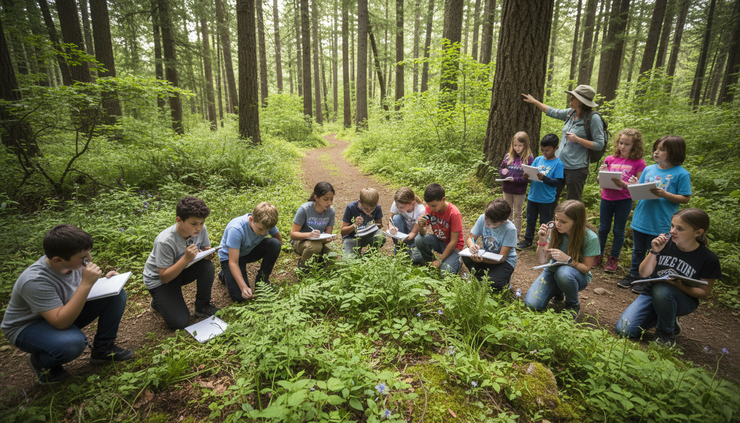
Outdoor learning makes STEM feel real
STEM often becomes more meaningful when students can see why it matters. The outdoors gives teachers a living lab filled with patterns, systems, measurements, and problems to solve.
A class studying ecosystems can observe relationships among plants, insects, birds, soil, water, and sunlight. Students do not only memorize terms such as habitat, adaptation, and biodiversity. They see those ideas at work. They can compare shaded and sunny areas, record signs of animal activity, and discuss what changes when a trail becomes crowded or a stream runs low.
Math also has a natural place outside. Students can use measurement and estimation to:
Calculate distance on a trail
Read maps and coordinates
Compare elevation changes
Track temperature over time
Estimate the height of a tree
Graph rainfall, wind speed, or cloud cover
These activities show students that math is not limited to a page. It helps people navigate, design, predict, and make decisions.
Engineering lessons fit well, too. Students might build a simple shelter, test a water filter, design a bridge from limited materials, or create a solution to reduce trail erosion. These tasks ask them to plan, test, fail, adjust, and try again. That process mirrors how scientists and engineers work.
The biggest academic gain is not only content knowledge. It is the habit of thinking carefully. Students learn to ask better questions, collect evidence, compare results, and explain their reasoning.
A school garden, nearby park, campus green space, nature center, or field station can all support this kind of learning. Schools do not need a remote wilderness site to make STEM come alive. A small outdoor area can become a place for weather data, plant studies, soil comparisons, geometry, journaling, and long-term observation.
Students build leadership and teamwork through shared challenges
Outdoor learning places students in situations where cooperation matters. A group navigation activity, for example, requires students to listen, read a map, divide roles, and make decisions together. A field investigation asks them to gather data accurately, manage equipment, and report findings. A stewardship project calls on them to plan work, follow safety expectations, and complete a task that benefits others.
These are practical leadership moments. They are not abstract lessons about character. Students practice leadership when they help a classmate across uneven ground, speak up with an idea, organize supplies, or encourage a group to keep going.
Outdoor programs can help students:
Build confidence through decision-making
Practice clear communication
Learn responsibility and accountability
Strengthen conflict resolution skills
Develop trust through shared effort
Understand how individual choices affect a group
Not every student leads in the same way. Some are comfortable giving directions. Others lead by noticing details, staying calm, including quieter classmates, or solving problems step by step. The outdoors gives schools more ways to recognize these different strengths.
This is also where leadership, lifeskills, adulthood readiness, and academic learning begin to overlap. Students learn to prepare for weather, manage time, care for equipment, follow instructions, assess risk, and take responsibility for their role. Those skills matter in school, work, family life, and community life.

Outdoor programs support student well-being
Many students spend long stretches of the school day indoors, seated, and focused on screens or printed materials. Outdoor programs bring movement, fresh air, and a change of setting into the learning process. That shift can help students return to academic tasks with more focus and energy.
Time outside also gives students a different kind of challenge. A trail walk, field survey, garden project, or team-building course asks students to use their bodies and senses. They hear birds, feel weather changes, notice textures, smell soil or leaves, and move through space. These experiences can be grounding, especially for students who struggle to sit still for long periods.
Outdoor learning can support well-being by giving students chances to:
Move during the school day
Practice calm observation
Build confidence through manageable risks
Work with peers in a less formal setting
Experience success outside traditional classroom tasks
This does not mean every outdoor activity has to be physically demanding. A quiet sit spot, nature journaling exercise, cloud observation, or garden reflection can be just as valuable. The key is to create a structured environment where students feel safe, included, and ready to participate.
Schools should plan for accessibility from the start. Strong programs consider mobility needs, sensory needs, weather conditions, allergies, student comfort, and clear behavior expectations. Outdoor learning works best when every student can take part in a meaningful way.
Environmental stewardship becomes a lived lesson
Schools play a major role in preparing students for responsible citizenship. Environmental stewardship is part of that work. Outdoor programs help students understand that communities depend on clean water, healthy soil, stable habitats, and thoughtful use of shared spaces.
A lesson about litter changes when students clean a campus or local park and then sort what they find. A unit on water quality becomes more urgent when students test a stream and discuss what might affect it. A conversation about native plants means more when students plant them, water them, and return later to see growth.
Students can take part in projects such as:
Maintaining gardens
Removing litter from community spaces
Planting native flowers, shrubs, or trees
Monitoring a stream, pond, or wetland
Creating signs that explain local habitats
Building compost systems
Designing pollinator areas
These projects teach more than environmental facts. They show students that their actions can improve a place. They also connect science with civic responsibility. Students learn that communities solve problems through planning, cooperation, and care over time.
Stewardship gives students a reason to see themselves as contributors, not just learners. That shift can be powerful.

Outdoor education strengthens classroom learning
A strong program does not replace classroom instruction. It extends it.
Before going outside, teachers can introduce vocabulary, background knowledge, safety expectations, and the main question for investigation. During the activity, students gather observations and evidence. Afterward, they return to the classroom to analyze data, write reflections, create presentations, compare results, or connect the activity to reading and research.
This sequence keeps outdoor learning tied to academic goals. It also helps teachers avoid the common problem of field trips becoming isolated events. The best programs are connected before, during, and after the outdoor experience.
For example, a fifth-grade water unit might include:
A classroom lesson on watersheds and runoff
A campus walk to observe where rainwater flows
A field investigation testing water clarity and temperature
A math lesson graphing the collected data
A writing assignment proposing ways to reduce pollution
A student presentation to classmates or school leaders
This kind of structure supports multiple subjects at once. Science drives the investigation. Math helps students interpret information. Writing helps them explain claims with evidence. Speaking skills come through discussion and presentation. Art can enter through sketching, mapping, or design.
Outdoor programs also support students who learn best through experience. Some students understand a concept more quickly when they can move, touch, test, and observe. Others gain confidence because the setting gives them new ways to participate.
Students can start small and still see value
A school does not need a large budget, mountain setting, or weeklong trip to begin. Many successful programs start with simple, repeatable activities close to the school building.
A courtyard can become a weather station. A patch of grass can support insect observations. A row of trees can be used for seasonal studies. A sidewalk can become a place to measure shadows and study the sun’s position. A nearby park can support mapping, journaling, plant identification, or fitness activities.
Good planning matters more than distance. Schools should focus on clear learning goals, safety routines, staff preparation, and student reflection.
Practical first steps include:
Identify outdoor spaces already available on or near campus
Connect one outdoor activity to an existing unit
Create simple safety and behavior expectations
Prepare materials in advance
Give students specific roles
Build in time for reflection afterward
Repeat activities across the year so students notice change
Teacher support is important. Staff need time to plan, understand safety procedures, and connect outdoor work to standards. Partnerships can also help. Nature centers, parks, conservation groups, farms, museums, local colleges, and community volunteers may offer materials, field sites, or expert guidance.
Schools should also think about weather and equity. Outdoor learning should not depend on students owning expensive gear. Programs can provide shared supplies when possible, choose activities that fit the season, and communicate clearly with families about what students need.
Outdoor learning prepares students for life beyond school
The long-term value of outdoor programs reaches beyond test scores. Students learn to solve problems in real places with real limits. They practice persistence when a design fails, patience when an observation takes time, and care when living things depend on them.
They also learn that knowledge is connected. A single outdoor investigation can involve biology, math, writing, teamwork, ethics, and community responsibility. That is how life works outside school. Problems rarely arrive sorted by subject.
For future careers, these experiences matter. Students may discover interest in environmental science, engineering, agriculture, public health, education, outdoor recreation, conservation, urban planning, or skilled trades. Even students who choose unrelated careers benefit from learning how to observe, collaborate, adapt, and make responsible choices.
Outdoor classrooms also help students build a stronger sense of place. They learn the names of local trees, notice seasonal changes, understand where water flows, and see how human choices affect nearby land. This can create a deeper connection to community.

The takeaway for schools
Outdoor programs work because they make learning active, connected, and memorable. They strengthen STEM instruction, build teamwork, support well-being, and teach students to care for the world around them.
The most effective programs are not random trips outside. They are planned learning experiences with clear goals, safe routines, meaningful reflection, and strong ties to classroom instruction.
Schools that start small can still make a lasting difference. A garden bed, walking trail, weather chart, campus cleanup, or stream study can give students something a worksheet cannot: the chance to learn with their hands, their senses, their classmates, and their community.


